
Safaa Khalaf
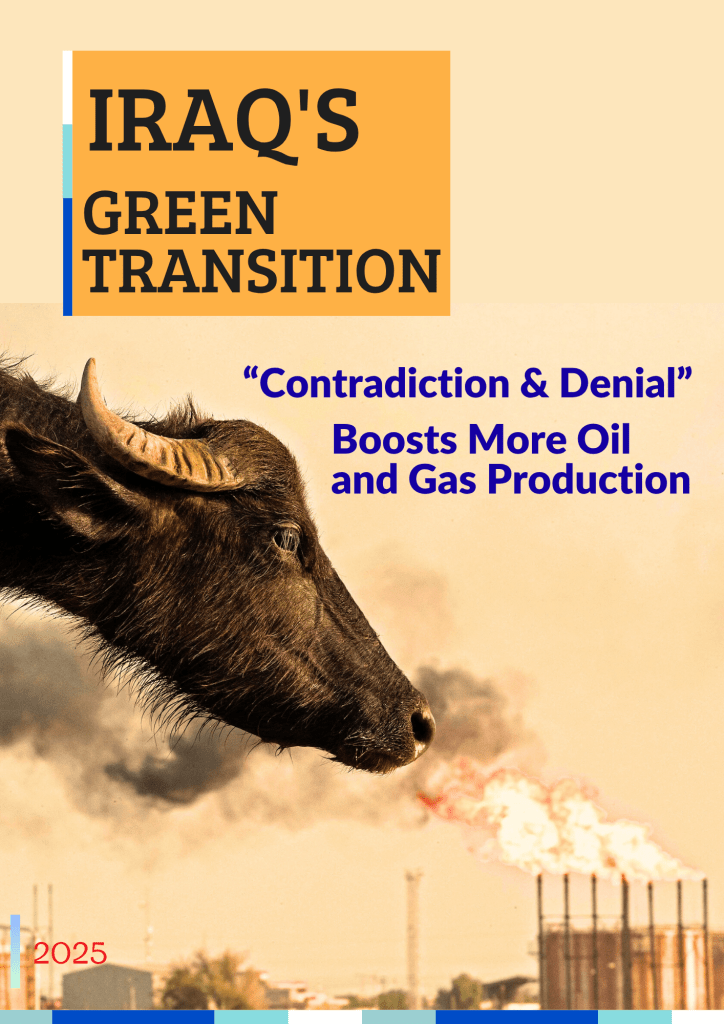
The Iraqi government’s dependency on fossil fuel extraction inhibits environmental measures, prioritising oil production for economic growth amid social unrest, poverty, and unemployment. Almost 30% of Iraqis live below the poverty line, while youth unemployment reaches 35%. Despite doubling oil production, environmental degradation continues to escalate, as evidenced by the increasing cancer rates in Basra, attributed to pollution. The government aims to increase production to 8 million barrels per day by 2027. Still, it faces barriers such as insufficient regulations and resistance from international oil companies, which complicates any efforts to transition to a greener energy source.
The Iraqi government’s reliance on fossil fuel extraction means that it is reluctant to implement effective supply-side measures that will threaten its plans to increase oil production and thus national income. The electricity generation, fossil fuel production, and transportation industries are responsible for 75% of the country’s emissions, with 40% emanating from oil and gas production alone. Yet the Iraqi oil economy is also a vital tool for preventing further domestic social unrest, which has risen in the context of corruption, political patronage, poverty and unemployment. 29.6% (12.27 million people) of Iraqis live below the poverty line, while youth unemployment has risen to 35%. Given this, it is no surprise that Iraq was one of the most vocal opponents to the ‘phase-out’ of fossil fuels in the final agreement at COP28 and COP29.
Governmental theory of justification of pollution
The Iraqi government is following the primary principle of ‘supply-side theory’ to fuel its oil ambitions: ‘Increases in the supply of goods and production through tax cuts and reduced regulations lead to economic growth.’ Consequently, the government believes that boosting oil production, even though it may result in more pollution, will lead to economic growth.
In parallel, to prevent foreign investors from leaving, the government is providing IOCs with more exemptions as part of oil licensing rounds contracts, such as tax cuts and fine removals, and reducing regulatory restrictions, especially environmental ones, in light of the high potential risk that BP will leave after the expiration of the Rumaila contract in 2032, for instance. However, there are unconfirmed reports that BP sold its stake to a new consortium (According to private sources), meaning it will exit the vast oil field earlier than initially planned.
Since 2010, Iraq has sought to rebuild its war-ravaged oil industry through extensive auction rounds, expecting international oil companies (IOCs) to drive the sector’s renewal. However, since 2018, IOCs have been leaving the country amid severe water shortages, ongoing political turmoil, unpaid debts, and the acquisition of more significant reserves by Russian and Chinese companies, leaving the industry in a precarious position. Despite doubling its oil production over the past decade and becoming one of the world’s top oil producers, Iraq’s development indicators still resemble those of low-income countries, according to the World Bank’s 2022 Climate Change and Development Report (CCDR).
More oil VS less development
Despite this, the government continues to pursue an increase in carbon-intensive production to finance the public budget, aiming for 8 million barrels per day by 2027. This approach contradicts and undermines its own environmental efforts while exacerbating the carbon emissions crisis. In contrast, the green cover necessary for “sequestering carbon” is declining. The area of cultivated or arable land has drastically reduced from 80 to 14 million dunams in a catastrophic response to the severe water shortage.
To develop Iraq’s oil sector, the World Bank, based on American and Western aspirations to expand Iraq’s contribution to the energy market, have proposed the Integrated National Energy Strategy (2013–2030), aiming to transform Iraq into “a major player in the global energy sector and petrochemical industries” by raising its production capacity by up to 14 million barrels per day by 2030.
The strategy promotes a hydrocarbon economy, often at the expense of the environment. It is based on overly optimistic assumptions, such as generating an additional $6 billion annually to the gross domestic product (GDP) and creating 10 million new job opportunities. However, the country has remained stuck in a production range of only 4 to 5 million barrels daily. In contrast, the goal of becoming a “major player” in the market remains an ambition tied to fluctuating production limits.
To justify its failure to fulfil its climate-related obligations and fund environmental initiatives, the Iraqi government has cited a $290 billion funding gap, as per the least-cost scenarios, alongside the depletion of financial resources during the counter-ISIS military campaign, the COVID-19 lockdown, and periods of oil price volatility. All of these, the government argues, hinder Iraq’s goals for sustainable development and progress towards a more environmentally responsible future.
The Human Cost of Fossil Fuel Pollutants
Mobile gas emissions pose a clear threat to Iraq’s environment and human health, particularly in Basra. However, the government’s indicators for local circulation or international decision-makers often lack any reference to oil extraction and wasted gas fuel pollutants.
Solutions to combat environmental degradation have been proposed for a long time. In 2015, the European Energy Commission proposed reducing gas burning levels and minimising heavy fuel oil and gas use for electricity generation to decrease carbon emissions by 25% in Iraq. However, despite these efforts, carbon emissions increased and exceeded international standards, particularly in Basra and southern production areas, leading to hurts caused by sustained pollution due to the flaring of heavily associated gas.
Due to the excessive increase in environmental pollution activity associated with oil production and associated gas burning, particularly in Basra, the Iraqi Cancer Council, affiliated with the Ministry of Health, confirms, according to an Iraqi Parliament report, that the prevalence of cancer in Iraq has increased significantly between 2003 and 2020. Basra, the hub of fossil fuel production, has a rising yearly infection incidence of 7.38% per 100,000 people. Furthermore, the city had the country’s highest infection incidence among children under the age of 15, at 14.93 per 100,000. On the other hand, the Office of the High Commission for Human Rights in Basra revealed in October 2023 that 9,000 people acquire cancer per year, with 60% of them residing near the city’s oil fields.
Clouds of methane are often present in Basra’s atmosphere due to the unclean extraction. In 2018, the gas flared within a 70-km radius of Basra, exceeding the total flaring volume during the same period in KSA, China, Canada, and India combined. In July 2021, Kayrros, a Paris-based company that analyses satellite data for ESA to track emissions, revealed that a western Basra field was releasing methane at 73 metric tonnes per hour, following two other methane emissions in mid-June at 181 and 197 metric tonnes per hour. The UK’s average annual emissions of over 200,000 cars cause thermal retention equivalent to 180 metric tonnes of methane.
Despite the illegality of gas flaring within 10 km of residential buildings under Iraqi law, residents in the heavily guarded Rumaila field are unable to move freely or bring in building materials to protect their homes from the polluted smoke spreading in the air. Polluted oil fumes have caused numerous deaths at an alarming rate. IOCs that operate in Basra’s various oil fields, whether in Rumaila (Northern or Southern), Majnoon, West Qurna 1 and 2, or Nahr Bin Omar, hire local security firms to ensure safety. However, these security companies are constantly assigned to suppress, displace, or terrorise the local population if they try to take action against IOCs due to environmental pollution.
Local firms operate as oppressive tribal militias, affiliated with influential families and political parties linked to Iranian militias and the Sadrist movement. Meanwhile, a Russian company operating in the West Qurna field has acquired 49% of the shares of an Iraqi security company suspected of widespread security and legal violations. Furthermore, international protection companies in Basra’s various oil fields are heavily involved in silencing the population’s voice and persecuting them. In contrast, the Iraqi National Security Service (INSS) employs the same tactics with greater cruelty.
Politically charged environmental measures
Despite the environmental damage caused by the growing hydrocarbon industry, coupled with the tonnes of pollutants released into the Iraqi skies, leading to the spread of incurable diseases and excessively high temperatures, Iraq still uses the outdated “1997 National Emissions Inventory”. It lacks an up-to-date national record of its CO2 emissions. In parallel, Iraq, whether in its bureaucratic structures or in the decision-making circles of politicians and parliamentary groups, does not intend to formulate and legislate laws to regulate carbon emissions generated from oil and gas fields or from large and outdated power plants.
Iraq is the world’s second-largest gas-flaring nation, following Russia, with an estimated flaring rate of 1.7 billion cubic feet per day (Bcf/d). This is compounded by the country’s highest fossil fuel emissions and severe air quality issues. The burning of approximately 570 billion cubic feet per year (Bcf/y) of unused gas significantly contributes to rapid and devastating pollution. In 2020, the waste of gas flaring in Iraq resulted in an estimated annual loss of approximately $2.5 billion, a sum that could have generated over 10 gigawatts of much-needed electricity. Additionally, Iraq imports up to 1 billion cubic feet per day (Bcf/d) of natural gas from Iran for power generation.
Geopolitics are closely linked to Iraq’s domestic environmental crisis. Iraq’s dependence on Iranian gas for electricity has heightened tensions between Iran and the United States. Although Washington has granted temporary exemptions for energy purchases, it has urged Iraq to achieve “energy independence” by exploring alternative sources beyond Tehran. Consequently, Iraq has implemented politically charged environmental measures. One notable initiative is a plan developed by Gaffney, Associates & Cline in 2018, which outlines a strategy for the Iraqi government to convert gas into energy over five years at a cost exceeding $44 billion.
In 2021, due to direct pressure from the US, Iraq initiated a five-year political plan that aims to invest in associated gas up to 2026 (by adding 400 Mcf/d to the Basra Gas Company’s production during 2023–2024 and then increasing rates to 2.6 Bcf/d by 2026). The primary objective is to halt the importation of Iranian gas, thereby reducing funding. The plan’s goals were not environmentally motivated. However, after Iraqi officials realised carbon capture is “very costly” and not a solution for Iraq, they shifted the plan to eliminate gas flaring to 2028 and reduce methane output by 30% by 2030.
Barriers to carbon reduction policies
* The first solid obstacle hindering the development of supply-side climate policies is the lack of progress in enacting a foundational regulatory framework. For instance, the “Oil and Gas Law,” which has been stalled for 18 years due to disputes over the privilege of wealth, revenues, investment, and export powers between the Iraqi federal government and the northern Kurds. The delay to introducing this legislation is hindering the development of a comprehensive regulatory system aimed at mitigating the fossil fuel economy.
* The second major challenge is the conflict between enacting environmental protection laws and reducing the carbon footprint, and the urgent need of the political regime to increase oil production to generate revenue for the public budget, expand the state network of clientelism, quell unrest, and provide opportunities for political and armed groups to engage in corruption with impunity.
* The third obstacle remains the fierce resistance from IOCs. Requiring IOCs to take more protective environmental measures or to better regulate supply through production ceilings or quotas means potentially increasing production costs, which could lead them to exit Iraqi fields, given the low profitability and high levels of risk. Warning of the risk of ‘capital flight’ is a persistent strategy deployed by the incumbent regime and features heavily in the policy discourse around fossil fuel production in Iraq.
Policy of contradiction and denial
If the global strategy to limit climate change hinges on mitigation and adaptation, the Iraqi model may be thought of as one of contradiction and denial. Iraqi government discourse views the environmental crisis as a ‘contextual crisis’ that is intertwined with the nation’s broader problems, which are being exacerbated by the creation of new ones. UNESCO’s Drought Management Report 2014 highlights that Iraq addresses its environmental issues through “disaster management” rather than “risk management.” This indicates a fundamental cognitive and structural distortion in the state’s thinking patterns and complex decision-making structures, which lack responsibility and governance.
The ongoing environmental crisis has led to a problematic and discriminatory approach in Iraq. It involves weighing the country’s inability to manage the movement of its citizens who are fleeing the harsh effects of climate change against policies that aim to prevent Iraq from becoming an unattractive region in the future. These policies also give a guarantee to global clients that Iraq will continue to remain a rising point of fossil production, regardless of the alarming extent of accelerating environmental degradation.
In response to the UNFCCC, Iraq’s “Nationally Determined Contributions on Climate Change Document (NDCs)” serves as the formal institutional framework for addressing environmental issues and carbon pollution. However, Iraq still needs to improve its standards in legislation and laws related to water, environmental preservation, and reducing pollutants and emissions from oil activity or energy production. However, with the assistance of the Iraqi government, the IOCs that control the extraction fields have found legal loopholes to avoid disclosing the extent of gas flaring, the impact of its pollutants, and the harmful environmental consequences.
The rampant institutional corruption in Iraq provided a comprehensive cover for these companies to abandon compliance with environmental controls, using a simple equation: more pollution in exchange for increased production.
The clientelistic nature of corruption in Iraq and the expansion of extractive activity into populated areas (the fifth and sixth licensing rounds, for example) have created a parallel economy based on the exploitation of oil expansion and pollution by both the IOCs and the local population, as the government supports IOCs by defending production sites as “taboo oil lands” according to the Hydrocarbon Wealth Preservation Law (84/1985). As an available and responsive solution, local residents bargain with the IOCs for jobs and commercial, logistical, and security contracts in exchange for agreeing to increase their exposure to pollution.
Basra is a striking example that demonstrates the harmful impact of the Iraqi state’s careless policies. Basra has become a hotspot for severe pollution. Currently, “oil taboo lands” occupy a significant portion of Basra’s territory, marked by extensive bulldozing in agricultural areas and assaults on surface water sources. These actions aim to deplete the orchards and the areas surrounding the oil fields, causing population displacement and environmental damage, ultimately leading to further unclean extraction.
The Iraqi government’s involvement in environmental, climate, and clean energy initiatives may create the impression that the country is dedicated to transitioning to cleaner energy sources. However, discussing energy transition without developing necessary policies and establishing a regulatory framework for its success undermines these claims and raises doubts about the government’s commitment to the transition. Currently, the oil industry does not face strict environmental regulations because the Ministry of Environment lacks the authority to enforce its standards against the Ministry of Oil and foreign investors.
In 2015, Iraq joined the Climate and Clean Air Coalition (CCAC), according to the NDCs path, within a politicised and conditional bargain to reduce emissions by 2030–2035, only by 1-2% as a unilateral national contribution. The percentage represents the extent to which the government denies the volume of fossil gases. After that, Iraq stipulated at the Paris climate talks that it would reduce its emissions to 15%, conditional on obtaining $100 billion in “donations” from the international community in exchange for “reducing emissions, adapting sectors, and achieving security.”
Despite the participation of three fragmented Iraqi delegations at the 2015 Paris Climate Conference, Iraq did not formally ratify the Paris Agreement until late 2021, as the climate crisis had not been a prominent feature on Iraq’s domestic political agenda. Above all, the Iraqi government’s concern has been that adhering to the Paris Agreement would negatively impact oil production due to tighter restrictions on methane and gas flaring. This explains why during the last three COPs: COP27, COP28 and COP29, Iraq strongly opposed the phase-down and phase-out of fossil fuels, as well as “contrary to the principles of the Paris Agreement.” The government commended the negotiators for their efforts in protecting the role of fossil fuels in development and preventing the adoption of harmful texts that some developed countries were pushing for, which, in the government’s view, would have hurt the interests of the Iraqi people.
Iraq has still to allocate funding for climate adaptation, despite government announcements to adopt a proactive path through the “Iraq Climate Conference,” held in the city most affected by carbon-intensive production, Basra, in March 2023. The second national voluntary report on the verification of sustainable development goals, moreover, did not include enhancing the environment or combating climate change. The government has allocated only $255 million to support Iraq’s fourth United Nations strategy, which focuses on improving natural resources, disaster risk management, and climate change mitigation. Meanwhile, the World Bank’s proposed clean investment vision is worth $233 billion by 2040.
Diminished civil society engagement
The lack of civil society engagement on climate issues indicates the erosion of the public sphere as a space for social activism against the regime’s violence and impunity. Local communities’ reluctance to mobilise and resist the expansion of polluting energy production, such as the burning of large amounts of gas in oil-rich areas like Basra, is particularly concerning. It indicates a selective approach to environmental mobilisation and a bias towards the state’s narrative, which prioritises increased production for job creation while avoiding discussions about the environmental consequences of oil production and national oil wealth. As a result, the focus is diverted from the environmental disasters caused by production fields. In general, however, environmental NGOs in Iraq often operate within the boundaries set by the state and sometimes align with its approach, which can lead to the politicisation of environmental issues.
Pollution is being shielded by the power of the law and by brute force. Basra and other areas, such as Dhi Qar, are recording a frightening increase in the number of people infected with or candidates for cancer. Meanwhile, authorities are suppressing protests that aim to halt or mitigate the harmful effects of industrial operations.
One way to silence environmental advocacy is through the use of anti-corruption tools. In May 2024, Radhi Muhammad Radhi, the director of the Basra Environment, was arrested on corruption charges, just one month after his appointment. However, the leading motivation is that Radhi filed a lawsuit against the oil companies operating the Majnoon field due to the increasing incidence of cancer among local residents and field workers.
Oil mafias linked to tribal groups subjected Radi to tremendous pressure, and his attempts to organise visits to oil sites according to judicial orders failed. Security companies and tribal groups allied with IOCs prevented environmental inspection teams from entering the points that had witnessed a steady rise in pollution rates and violations of environmental standards. The authorities subsequently announced that they had accused Radi of corruption. This is a concerning indication that the authorities are using the fight against corruption to silence voices and issues related to environmental advocacy.
In sum, Iraq’s shift towards a low-carbon economy will impact jobs and activities that rely on oil production, creating risks that could threaten the country’s political stability and lead to significant economic and societal changes. As a result, the Iraqi government hesitates to engage in large-scale green transformation processes that may not align with the rentier society’s dependence on government funds and belief in state centralisation. Both the cause of and the proposed solution to Iraq’s political and financial woes, fossil fuel production will continue to dominate and complicate the country’s environmental trajectory.
 صفاء خلف - Safaa Khalaf